The Serenade
Find an accomplice
Prompt 1
PART 1 OF 2 · FORMAT & REFERENCES FORMAT: same duration and aspect ratio as @Video 1 / two-pet replacement / keep original cuts REFERENCES: @Video 1 is the camera, edit, timing and motion-capture master. It is uploaded muted. Treat it as a motion-capture track: each new pet's body follows the original pet's body pose-for-pose, frame by frame — same head angle, same eye direction, same ear position, same mouth opening, same paw position, same posture, same body sway, at the exact same moment, speed and direction. Keep the same shots, cut points, shot durations, camera framing and movement, the same wooden pier, blue water, sandy beach, sky, golden-hour sunlight and color grading. It contains two performers: the GAZER — the black cat with the red bandana who sits on the pier looking at the sea — and the SINGER — the long-haired orange-and-white cat. Both must be fully replaced in EVERY shot — close-ups, medium shots, wide shots, tiny distant figures, silhouettes and back views. Neither original cat may remain anywhere in the video, and neither original cat's fur, eyes or bandana carries over. @Image 1 defines ONLY the new GAZER. It can be a cat or a dog. Preserve this animal's face, eye color, eye condition, fur color, fur pattern, fur length, ear shape, nose, body size and proportions exactly as shown in @Image 1, including any unique features such as a different or cloudy eye, a scar, a missing ear tip or special markings. Keep any collar, bandana or accessory only if visible in @Image 1. Do not inherit the background, floor, furniture or lighting from @Image 1. [optional: short description of the gazer pet, and any unique feature with its exact side, e.g. "black cat, the cat's LEFT eye is cloudy and blind"] @Image 2 defines ONLY the new SINGER. It can be a cat or a dog. Preserve this animal's face, eye color, eye condition, fur color, fur pattern, fur length, ear shape, nose, body size and proportions exactly as shown in @Image 2, including any unique features. Keep any collar, bandana or accessory only if visible in @Image 2. Do not inherit the background, floor, furniture or lighting from @Image 2. [optional: short description of the singer pet, and any unique feature with its exact side]
Tutorial
DENIZ AKKABAK · PET SWAP TUTORIAL · @DENIZ.AKKABAK
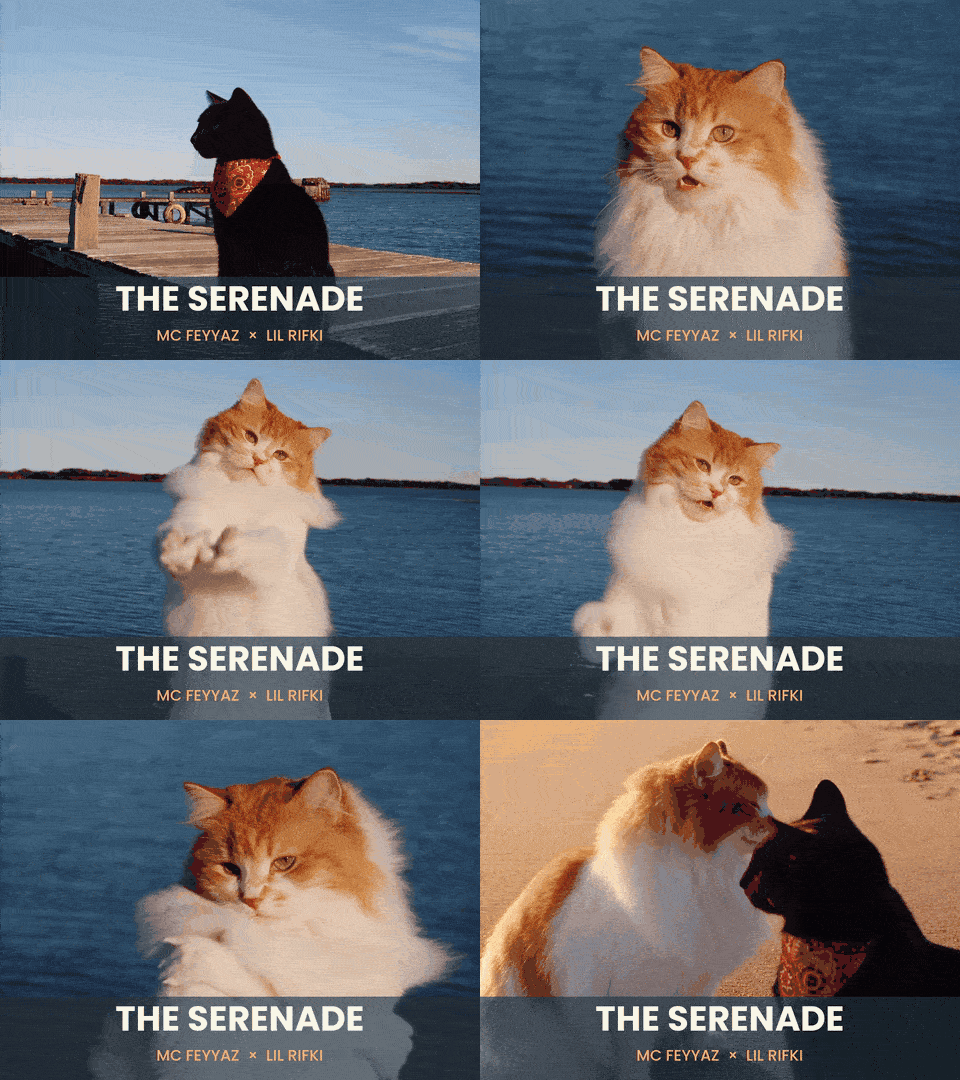
The Serenade
How to recast any two pets in a golden-hour love song — eleven shots, close-ups to tiny figures on a pier — in a single generation.
A TUTORIAL BY DENIZ AKKABAK · @DENIZ.AKKABAK
PIPELINE SEEDANCE 2.5 FORMAT MATCHES THE REFERENCE GENRE PET MUSIC VIDEO
Close-ups are easy. A cat singing straight into the lens fills the frame, and any model will happily swap it. The trouble starts when the camera pulls back — two dots at the end of a pier, two silhouettes on a sunset beach. My first pass left those untouched: the model read them as scenery, not as characters. The fix wasn’t a better description of the pets. It was a map. This prompt names who stands where in every one of the eleven shots, and treats the reference as motion capture — so both performers get swapped everywhere, pose for pose, in one generation.
THE PIPELINE AT A GLANCE
- 01
Get the reference
Download the reference video from the prompt’s page on lootprompt.com and make sure it’s silent. This file is your @Video 1.
- 02
Cast your pets
Two photos, two roles. @Image 1 is the gazer on the pier, @Image 2 is the singer.
- 03
Generate
Attach all three in order, paste the prompt, match duration and aspect ratio to the reference, render once.
STEP 01 — LOOTPROMPT.COM
Download the Reference — It Is Your @Video 1
The prompt never describes a single pose. It points at @Video 1 and says follow it frame by frame — every blink, every paw to the cheek, every nuzzle, every cut. Without the reference attached as a real file, there is nothing to follow.
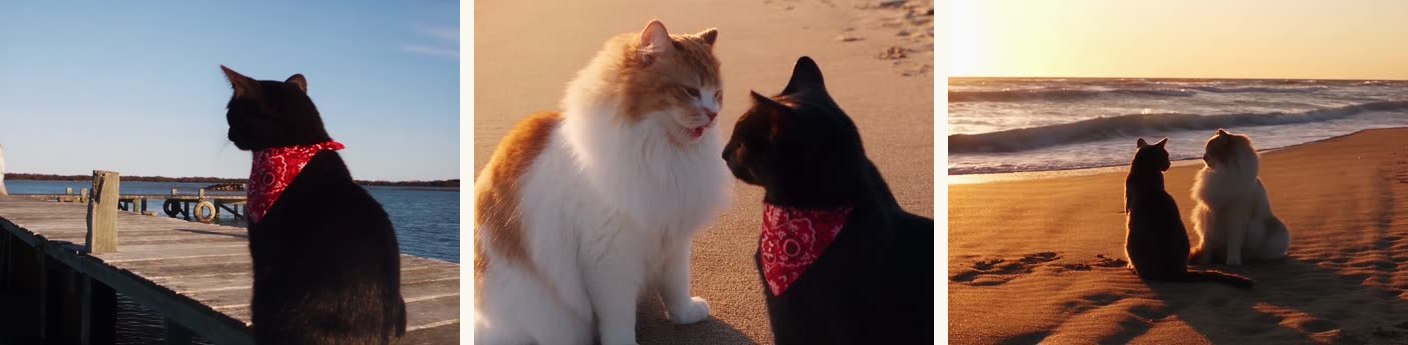
Open this prompt’s page on lootprompt.com and hit Download under the video — that’s the reference, ready to use. You can also save the reel from my Instagram post (@deniz.akkabak). Either way it goes into the references as @Video 1. MC Feyyaz and Lil Rıfkı are in it, and that’s exactly right: the prompt keeps their performances and throws away their identities.
@VIDEO 1 — THE REFERENCE, THREE MOMENTS
STEP 02 — AUDIO OFF
Make Sure It’s Silent — or Seedance Won’t Render
A love song is copyrighted, and Seedance checks the audio of every reference you attach — a copyrighted track gets the generation blocked before a single frame is made. If your file has any sound on it, strip it before uploading. The singing lives in the mouth movements, not the audio.
AUDIO CHECK — BEFORE YOU UPLOAD
Mute the clip and export a new file. On iPhone: Photos → Edit → tap the speaker icon so it’s crossed out → Done. In CapCut or any editor: mute the clip, export.
Attach the silent file, not the original. Same length, same frames — only the audio track is gone. Every lip movement is still in the pixels.
Add the song back at the end. The render comes out silent with the mouth on the original timing — lay the track back in your editor or pick it when you post.
STEP 03 — CASTING
Cast Your Pets — The Gazer and the Singer
Two photos, two roles, and the order is the casting. @Image 1 becomes the gazer — the quiet one on the pier, the one who gets nuzzled. @Image 2 becomes the singer — every close-up, every paw to the cheek. Cats, dogs or one of each: the prompt only cares who goes in which slot. Give the singer role to your most expressive face.
Choose photos the way a casting director would: one animal per photo, face toward the camera, both eyes visible, good light, head and chest in frame. Clear fur colors matter more than usual here — in the wide shots, color and markings are all that’s left to recognize your pet by.
REFERENCE INPUTS — THE STARS OF THIS VERSION
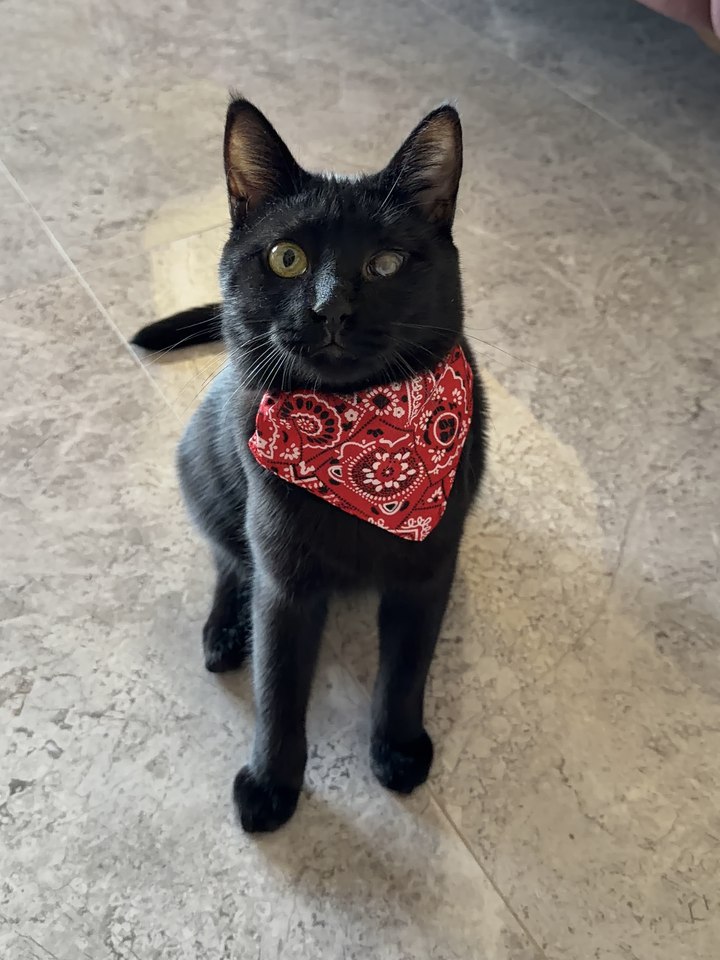
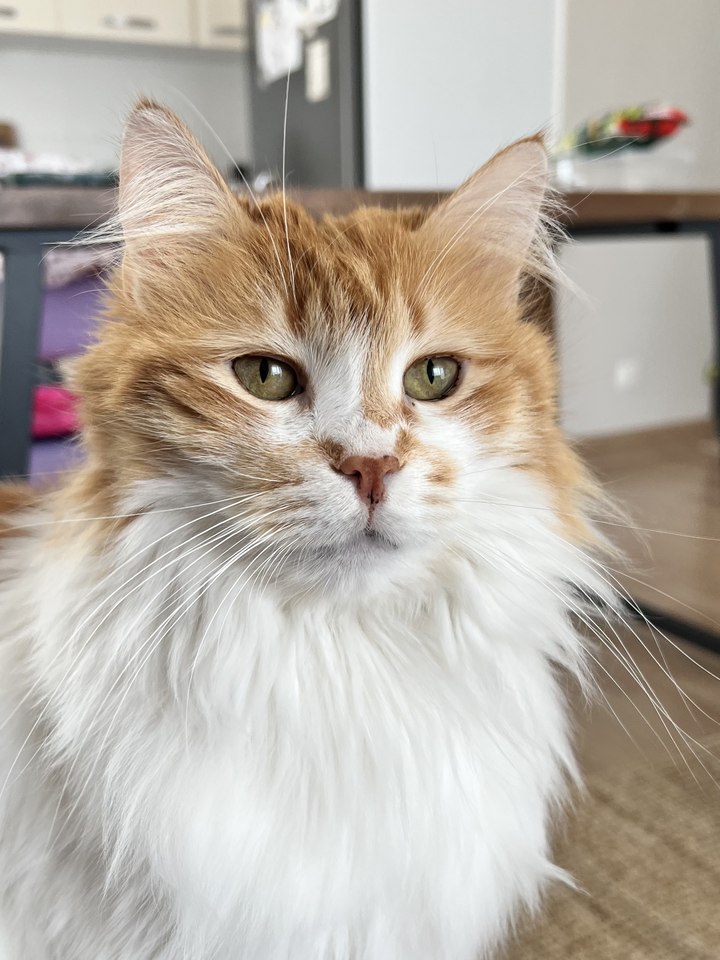
Name one-sided features from the pet’s point of view. Lil Rıfkı is blind in his left eye, and on the beach he faces screen-left — so his blind eye is the one the camera sees. That’s exactly the kind of detail a model mirrors. If your pet has anything one-sided — an eye, a scar, a folded ear, a patch — fill in the [optional] line with the side as the pet sees it: “the cat’s LEFT eye is cloudy and blind.” Nothing to add? Delete the bracket lines.
STEP 04 — SEEDANCE
Generate — One Prompt, Three References
Open Seedance in reference-to-video mode. Attach the three files in exactly this order, set the duration and aspect ratio to match the reference, paste the prompt, and render. One pass is enough — the shot map is what makes the full 28 seconds hold together.
REFERENCE INPUTS — ATTACH IN THIS ORDER
- 01
@Video 1
The silent reference. Camera, cuts, poses, lip sync, pier, beach and light.
- 02
@Image 1
Your gazer — the one on the pier.
- 03
@Image 2
Your singer — every close-up.
Prompt 1
PART 1 OF 2 · FORMAT & REFERENCES
same duration and aspect ratio as @Video 1 / two-pet replacement / keep original cuts
@Video 1 is the camera, edit, timing and motion-capture master. It is uploaded muted. Treat it as a motion-capture track: each new pet's body follows the original pet's body pose-for-pose, frame by frame — same head angle, same eye direction, same ear position, same mouth opening, same paw position, same posture, same body sway, at the exact same moment, speed and direction. Keep the same shots, cut points, shot durations, camera framing and movement, the same wooden pier, blue water, sandy beach, sky, golden-hour sunlight and color grading. It contains two performers: the GAZER — the black cat with the red bandana who sits on the pier looking at the sea — and the SINGER — the long-haired orange-and-white cat. Both must be fully replaced in EVERY shot — close-ups, medium shots, wide shots, tiny distant figures, silhouettes and back views. Neither original cat may remain anywhere in the video, and neither original cat's fur, eyes or bandana carries over. @Image 1 defines ONLY the new GAZER. It can be a cat or a dog. Preserve this animal's face, eye color, eye condition, fur color, fur pattern, fur length, ear shape, nose, body size and proportions exactly as shown in @Image 1, including any unique features such as a different or cloudy eye, a scar, a missing ear tip or special markings. Keep any collar, bandana or accessory only if visible in @Image 1. Do not inherit the background, floor, furniture or lighting from @Image 1. [optional: short description of the gazer pet, and any unique feature with its exact side, e.g. "black cat, the cat's LEFT eye is cloudy and blind"] @Image 2 defines ONLY the new SINGER. It can be a cat or a dog. Preserve this animal's face, eye color, eye condition, fur color, fur pattern, fur length, ear shape, nose, body size and proportions exactly as shown in @Image 2, including any unique features. Keep any collar, bandana or accessory only if visible in @Image 2. Do not inherit the background, floor, furniture or lighting from @Image 2. [optional: short description of the singer pet, and any unique feature with its exact side]
PROMPT — PART 2, PASTE DIRECTLY AFTER PART 1
PART 2 OF 2 · SHOT MAP, PERFORMANCE & LOCKS
SHOT MAP — who is where, in order:
Shot 1 (pier, from behind): the GAZER sits on the edge of the pier facing the water, seen from behind and then in profile as the camera moves; same slow head turns.
Shot 2 (close-up by the water): the SINGER sings to camera, same mouth shapes and blinks.
Shot 3 (beach, golden hour, close two-shot): SINGER on screen-left, GAZER on screen-right facing screen-left toward it; they lean in and nuzzle exactly as the original pets.
Shot 4 (close-up by the water): the SINGER sings, same mouth and head movement.
Shot 5 (medium, standing on the pier): the SINGER stands upright and raises its paw to its face exactly like the original.
Shot 6 (close-up): the SINGER with paw at its cheek, same flirty glances, blinks and mouth shapes.
Shot 7 (medium, standing on the pier): the SINGER stands upright and waves its paw exactly like the original.
Shot 8 (extreme wide, whole pier): at the far end of the pier, two small upright figures — the GAZER on the left and the SINGER on the right. Even tiny and distant, their fur colors and markings are clearly the new pets'.
Shot 9 (close-up by the water): the SINGER sings with paw at its chest, same movements.
Shot 10 (wide beach at sunset, from behind): two pets sit on the sand facing the sea — the GAZER on the left, the SINGER on the right; their fur colors, markings and any accessories are readable even from behind.
Shot 11 (beach, close two-shot): same as Shot 3 — SINGER left, GAZER right facing it, nuzzling exactly as the original pets.
VIDEO PROMPT:
Recreate @Video 1 following the SHOT MAP exactly. The pet from @Image 2 copies every singing moment of the original singer 1:1: the mouth opens, closes and shapes every word at the same moments and to the same width so the original song lines up in the edit, with the same dreamy slow blinks, closed-eye long notes, shy flirty glances into the lens, paw raised to the cheek, paw wave, paw to the chest, head tilts and gentle sway. The pet from @Image 1 copies every moment of the original gazer 1:1: the same calm gaze over the water, the same head turns, the same lean and nuzzle on the beach. Each pet keeps the exact screen position, scale, framing and silhouette placement of the pet it replaces, while keeping its own species, breed, fur length, muzzle shape and body build; if a pet is larger or smaller, keep its body center and contact points identical and scale the body naturally. Any unique facial feature stays on the correct side of the face in every shot and every head turn, exactly as in its reference image, never mirrored. Golden sunlight glows through each pet's fur naturally. Photorealistic, real fur physics, natural animal anatomy, romantic music-video mood.
Camera lock: every shot is a frame-by-frame copy of the matching shot in @Video 1: same start frame, same framing, same movement, same speed, same duration, same cut point. Do not slow down, shorten, extend, merge or remove any shot.
AUDIO: silent. No music, no singing voice, no sound effects.
CONSISTENCY: Exactly two animals in the whole video: the @Image 1 pet as the GAZER and the @Image 2 pet as the SINGER, in every shot of the SHOT MAP, at every size and from every angle. They never swap roles or sides. Unique features and accessories present on the correct side in every shot. Pier, water, beach, light, camera, cuts and timing identical to @Video 1.
NEGATIVE PROMPT: no original cats from @Video 1 anywhere, no original cats in wide shots, no original cats in distant shots, no original cats seen from behind, no third animal, no swapped roles, no swapped sides, no gazer singing, no identity change, no breed change, no species change, no mirrored face, no eye change, no missing or moved unique features, no added accessories, no fur pattern drift, no pose different from @Video 1, no paw movement different from @Video 1, no mouth movement out of sync with @Video 1, no slow motion, no shortened or missing shots, no change to camera path, speed or cut points, no flicker, no cartoon, no cheap CGI, no on-screen text, no watermark.
STEP 05
Anatomy — Why It Holds Together
- 01
Motion capture, not inspiration
@Video 1 is a “motion-capture track: each new pet’s body follows the original pet’s body pose-for-pose.” Head angle, eye direction, ear position, paw position — listed one by one, so the model copies the skeleton instead of the vibe.
- 02
Replace at every size
“Fully replaced in EVERY shot — close-ups, medium shots, wide shots, tiny distant figures, silhouettes and back views.” Without this, anything small enough gets treated as background and survives untouched.
- 03
The shot map
Eleven lines, one per shot, each naming who stands where: “the GAZER on the left and the SINGER on the right.” Roles by job, not by look — so the same map works for any two pets.
- 04
Readable from behind
Shots 8 and 10 demand that fur colors and markings stay “readable even from behind” and “clearly the new pets’” even when tiny. Color is the only identity a distant figure has.
- 05
Lip sync without sound
“The mouth opens, closes and shapes every word at the same moments and to the same width.” The song is gone from the file, but the timing lives in the pixels, so the track drops back in and lines up.
- 06
Identity marks, sided
“Any unique facial feature stays on the correct side … never mirrored,” backed by the optional line. The beach shots turn one side of the face to camera — exactly where a mirrored eye or ear would show.
- 07
The camera lock and the insurance
“Same start frame, same framing, same movement, same speed, same duration, same cut point.” The NEGATIVE list closes the rest: “no original cats in distant shots,” “no original cats seen from behind,” “no pose different from @Video 1.”
THE RESULT
Output — MC Feyyaz × Lil Rıfkı
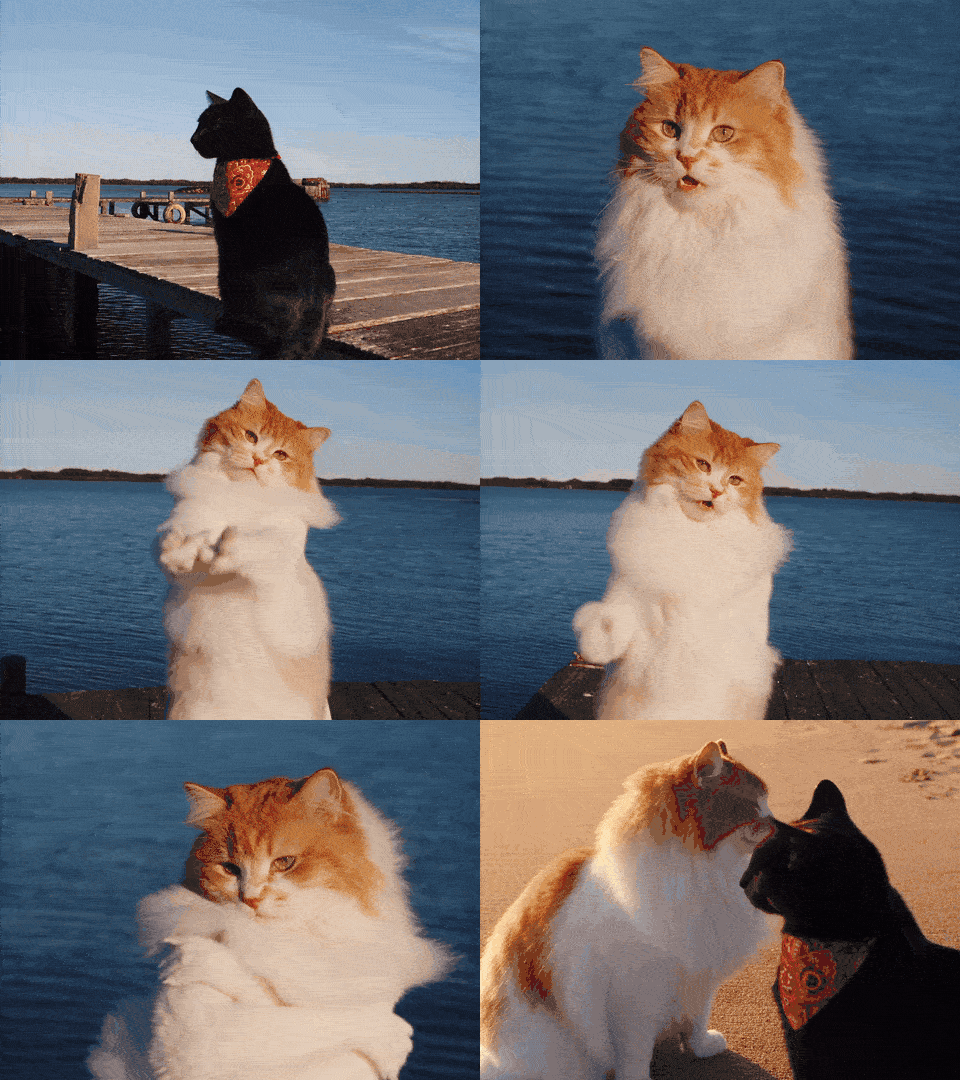
Check yours against the reference shot by shot, and look hardest at the wide ones: the two figures at the end of the pier and the two silhouettes on the sand should be your pets, not the originals. Then check the close-ups — mouth on the same frames, paw to the cheek on the same beat, nuzzle at the same moment. If a wide shot slips, cut the reference at its edit points, render that section on its own with only its shot-map lines, and splice it back in — the cuts hide the join.
ELEVEN SHOTS. ONE TAKE. TWO PETS.
A model only changes what you point at. So point at everything.
Swap the pier for any multi-shot clip — a wedding film, a road trip, a sitcom opening — and swap the photos for the two who share your couch. The skeleton carries all of it: one muted reference treated as motion capture, one image per role, and a shot map that names every performer in every shot, down to the smallest figure at the end of the frame. That last part is the one people skip, and the one that makes it work in a single pass.
WRITTEN, DIRECTED & PROMPTED BY DENIZ AKKABAK · @DENIZ.AKKABAK